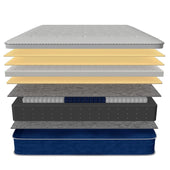
If you only check one specification before buying a foam or hybrid mattress, make it foam density. It is the single best predictor of how long a mattress will last, yet it is the number most marketing carefully avoids.
This guide explains what foam density actually measures, what counts as good, and why low density is the real reason cheap mattresses sag.
What Foam Density Actually Measures
Foam density is the mass of foam per cubic metre, written as kg/m3. It tells you how much actual foam material is packed into a given volume.
Higher-density foam contains more material, which generally means it is more durable and supportive over time. Crucially, density is not the same as firmness, which is where most confusion starts.
Density vs Firmness vs ILD
These three terms get muddled constantly, so here is the plain-English version.
| Term | What it measures | What it tells you |
|---|---|---|
| Density (kg/m3) | How much foam material is packed in | Durability and quality |
| Firmness | How hard or soft it feels | Comfort and feel |
| ILD | Force to compress the foam | A technical firmness measure |
A high-density foam can be soft, and a low-density foam can be firm. Density is about how long it lasts, not how it feels. For the firmness side, see our explainer on what ILD means.
What Counts as a Durable Density
As a general guide for comfort and support foams, higher density correlates with longer life. Budget mattresses often use lower-density foams to cut cost and weight, which feel fine in the showroom but break down faster.
A heavier mattress is often a sign of higher-density foams and more steel in the springs. If a mattress feels surprisingly light for its size, ask about the foam density.
Why Low-Density Foam Sags
Low-density foam has more air and less material, so it compresses permanently under repeated load. Over months, that shows up as body impressions and a loss of support, especially where you carry the most weight.
This is why two mattresses that feel identical in store can age completely differently. The cheaper one with low-density foam develops a sagging dip, while the higher-density one holds its shape. If your current mattress has a visible dip, our guide on body impressions versus sagging explains what is normal and what is a defect.
How Density Affects Price, Weight and Lifespan
Higher-density foam costs more to produce, weighs more to ship, and lasts longer. That is the honest trade-off. A quality mattress with dense foams will cost a little more upfront but spreads that cost over many more years of proper support, which usually makes it better value. We unpack this in our guide to buying a budget mattress without regret.
Questions to Ask Before You Buy
Before committing, get clear answers on these.
- What is the density of the comfort and support foams?
- What warranty is offered, and what sag depth does it cover?
- Is there a sleep trial so you can test it at home?
A brand confident in its materials will answer these without hesitation.
Frequently Asked Questions
What is a good foam density for a mattress?
Higher is generally more durable, but the right figure depends on whether it is a comfort layer or a support layer. Rather than chasing a single number, compare the density a brand quotes against the warranty and price, and be wary of any mattress that hides the figure entirely.
Does higher density mean firmer?
No. Density measures how much material is in the foam, not how hard it feels. A dense foam can be plush and soft, while a low-density foam can feel firm. Firmness and density are separate things.
Why does cheap memory foam sag?
Because it usually uses low-density foam, which has less material and compresses permanently under repeated weight. The result is a sagging dip and lost support within a year or two.
How does density affect mattress lifespan?
Density is the strongest material predictor of lifespan. Higher-density foams resist permanent compression, so the mattress keeps its shape and support far longer than one built with low-density foam.