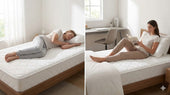
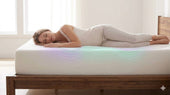
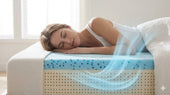
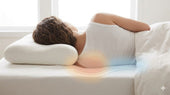
The best mattress for couples in Australia is one that feels comfortable and supportive to both people, limits unwanted movement across the bed, and fits your shared space. A queen is often a practical starting size, while a king offers more personal room. But if one partner prefers plush cushioning and the other likes a firmer feel, mattress size alone won't solve the problem.
Start by comparing how each of you sleeps, then test firmness, partner disturbance, edge support and temperature comfort together. Here's how to decide without assuming the most expensive or firmest mattress must be best.
What Makes a Mattress Good for Couples?
A mattress for two sleepers has to handle preferences that may not match. One person might sleep on their side and notice pressure around their shoulders. The other may move frequently, sleep on their back or prefer a firmer surface.
The most useful features to compare are:
- Comfort for both bodies: Enough cushioning and support for each partner, rather than a fixed firmness score.
- Motion isolation: How much movement travels across the surface when somebody changes position or gets up.
- Edge support: How stable the mattress feels near its perimeter, especially on a narrower bed.
- Temperature comfort: How warm each person feels with the cover, sheets and doona in place.
- Size and durability: Enough room for two and suitable support for the combined load.
If you and your partner disagree, decide which issues genuinely disturb sleep and which are simply preferences. That makes it easier to assess the trade-offs between mattress types.
How Do Couples Choose a Mattress When They Prefer Different Firmness Levels?
Start with the firmness each person finds comfortable separately, then test a shared option together. Medium or medium-firm is a reasonable place to begin if both preferences are close, but there is no scientifically established 7/10 setting that suits all couples. Firmness labels are subjective and can differ between brands.
One Side Sleeper and One Back or Stomach Sleeper
A side sleeper may prefer more cushioning around the shoulder and hip. Someone who sleeps mainly on their back or front may prefer a surface that resists excessive sinking.
The challenge is finding a mattress with comfortable surface cushioning and a support system that works for both—not simply buying the firmest option.
Partners with Different Body Weights
The same mattress can feel softer to one person and firmer to another, depending on how their weight is distributed.
Don't use a fixed weight cut-off to choose firmness. Both partners should lie on their usual sides of the mattress and assess comfort, movement and support over time.
When Compromise Doesn't Work
If your firmness preferences are far apart, investigate split-firmness mattresses or suitable dual-adjustable systems, where each side can be configured differently.
Check the actual design before buying: not every king mattress allows two different firmnesses, and separately adjustable bases require compatible mattresses.
What Mattress Type Is Best for Couples?
There isn't one winner across every category. Materials and construction influence how a mattress responds to movement, body pressure and heat, but two models of the same type can perform differently.
|
Mattress type |
Potential advantages for couples |
What to check |
|
Memory foam |
Often absorbs movement and contours around the body |
Heat comfort, ease of changing position and edge feel |
|
Pocket-spring hybrid |
Can combine independent spring movement with cushioning and responsive support |
Motion transfer, surface bounce, edge structure and comfort layers |
|
Latex or latex hybrid |
Often feels responsive and easier to reposition on |
Whether its bounce is noticeable to a partner and how warm it feels |
|
Traditional connected-spring mattress |
Familiar spring feel and potential airflow around the support unit |
Whether movement transfers across connected coils |
|
Split-firmness or dual-adjustable design |
Can address substantially different preferences |
Size compatibility, gap between sides, cost and return terms |
Try before deciding where possible. Spring count, an advertised firmness number or the word cooling does not by itself establish that a mattress will work for both of you.
Does Motion Isolation Matter for Couples?
Yes, particularly if one person is easily disturbed when the other turns over or gets out of bed.
Motion isolation describes how well a mattress limits movement travelling across the surface; it doesn't mean the sleeper will never wake up.
Individually wrapped pocket springs can move more independently than connected spring units. Memory foam may also absorb movement effectively.
Actual results depend on the complete mattress design, including upper comfort layers and firmness.
The Sleep Foundation's mattress glossary distinguishes motion isolation from firmness, edge support and other features.
For a deeper explanation of how movement travels through different constructions, see DuuDuu's guide to motion isolation for couples.
A Simple Two-Person Movement Test
Lie in your normal sleeping positions. Have one partner roll over, sit at the edge and get up while the other remains still.
Swap roles.
Notice not only movement through the mattress but also noise from the bed frame. Repeat after spending enough time lying on the mattress for an initial impression of comfort.
Double vs Queen vs King: Australian Mattress Sizes for Couples
For most couples, a queen (153 × 203 cm) is a useful size to compare first. A king adds 30 cm of width, while a double is shorter and leaves less personal room.
The best option still depends on your bedroom, bed frame and budget.
|
Mattress Size |
Dimensions (cm) |
Dimensions (in inches) |
Best For |
|
Double |
138 × 188 cm |
54.3 × 74.0 in |
Occasional sharing or couples with limited floor space |
|
Queen |
153 × 203 cm |
60.2 × 79.9 in |
Couples wanting a balance of personal space and room fit |
|
King |
183 × 203 cm |
72.0 × 79.9 in |
Couples wanting extra width, including restless sleepers |
Measurements are width × length. Inches are approximate and rounded to one decimal place.
If each person uses half the width, a double offers 69 cm per person, a queen 76.5 cm, and a king 91.5 cm.
These are useful comparisons, not guaranteed comfort allowances; pillows, sleep position and the bed frame matter too.
Measure the full external bed frame, not just the mattress. Leave room for doors, drawers and walking paths.
DuuDuu's Australian bed size guide covers all standard sizes and planning details separately.
What If One Partner Sleeps Hot and the Other Feels Cold?
First adjust the bedding and room conditions before expecting a mattress to fix the difference.
Two sleepers share the mattress but need not share identical blankets or sleepwear.
Try separate doonas or lighter layers, breathable sheets suited to each person's preference, and manageable airflow.
Foam, latex and spring constructions can feel different in practice, but no material guarantees a fixed skin temperature or a specific amount of deep or REM sleep.
Humidity, protectors and bedding can all affect comfort.
For hot Australian nights, block daytime sun, ventilate when outdoor conditions are suitable and use safe cooling when needed.
If one partner runs hot, test the mattress with the same protector and bedding you actually plan to use.
Why Edge Support, Ease of Movement and the Base Matter
A stable perimeter can make a mattress feel more usable, especially if both sleepers lie close to the sides.
Sit and lie near the edge to see whether it feels supportive; an advertised reinforced edge isn't a substitute for a real test.
Ease of movement also matters. Some cushioning layers feel slow to respond when someone changes position, while others spring back quickly.
Couples should test whether either partner finds repositioning awkward or whether extra bounce disturbs the other.
Finally, check the bed base's rated load, construction and compatibility.
Consider the mattress plus the weight of both sleepers. The manufacturer's base instructions are more reliable than assuming every hybrid needs an identical slat gap.
Is the DuuDuu Hybrid Mattress Worth Considering for Couples?
The DuuDuu Mattress is an option to compare if you want a single-feel hybrid.
Its current product listing describes natural latex and foam comfort layers, three-zone pocket springs, a TruCool fabric cover and reinforced Guardian Form edges.
These features are relevant to support, movement and perimeter stability, but the listing alone does not establish a quantified reduction in partner disturbance or bedroom temperature.
The published size options include double, queen, king, king single and super king, with a listed mattress depth of 30 cm.
Confirm the current price and stock of the size you want at checkout; availability can vary by variant, and the live page currently shows inconsistent stock messaging.
DuuDuu also advertises a 100-night mattress trial and 10-year structural warranty.
Read the current trial and refund conditions before purchasing: its voluntary trial includes eligibility requirements, a minimum-use period and exclusions. Those commercial conditions are separate from your rights under Australian Consumer Law.
Couples' Mattress Buying Checklist
Before placing an order, each partner should be able to answer these questions:
- Sleep positions: Where do we need cushioning, and where do we want a firmer feel?
- Partner disturbance: Can we feel each other turning, sitting or getting out of bed?
- Size: Does a queen provide enough width, or does a king justify the extra floor space?
- Temperature: Have we tested the mattress with our actual sheets, protector and doona?
- Edge and movement: Can we sit near the side and reposition without feeling unstable?
- Base compatibility: Is our existing frame suitable for the chosen mattress and combined load?
- Trial terms: Will both of us have time to test it, and what conditions apply to a voluntary return?
- Budget: Are we comparing genuine specifications and overall value, not only promotional claims?
During an eligible home trial, both partners should record the comfort issues that matter most—such as movement, temperature and pressure—rather than relying on one person's first night.
Frequently Asked Questions About Mattresses for Couples
What is the best mattress for couples with different sleep preferences?
The best choice is a mattress both partners find comfortable and supportive in their usual sleeping positions. If one likes plush and the other firm, test a balanced model together or investigate genuine split-firmness designs.
Is a medium-firm mattress best for couples?
Medium-firm can be a sensible starting point, not a universal answer. Firmness ratings vary across brands and feel different depending on body weight and sleeping position. Both partners should assess the actual mattress.
Which mattress reduces partner disturbance?
Mattresses with effective motion isolation can help reduce noticeable movement across the bed. Memory foam and well-designed pocket-spring hybrids are worth testing, but no construction guarantees zero disturbance.
Is a hybrid or memory foam mattress better for couples?
It depends on which features matter most. Memory foam often performs well for motion absorption, while some hybrids balance independent springs with a more responsive feel. Compare complete models rather than assuming all hybrids or all foams behave alike.
Is a queen or king mattress better for two people in Australia?
A queen is a practical starting size for many couples; a king provides 30 cm more width. Choose based on how much room you want to share and whether the full bed frame fits comfortably in the bedroom.
Can couples choose different firmness levels on each side?
Yes, with compatible split-firmness or dual-adjustable products. Check how the system is built, whether it introduces a centre gap and whether each side can actually be changed independently.
What if one partner sleeps hot and the other cold?
Try different bedding layers, separate doonas and appropriate room ventilation first. Mattress materials may affect comfort, but no product can guarantee two distinct sleeping temperatures on one shared surface.
How should couples test a mattress during a sleep trial?
Both partners should use their usual sleeping positions and assess firmness, movement, edges and temperature over time. Check the retailer's eligibility rules and return conditions before buying; an advertised trial is not automatically an unconditional refund.
Choose a Mattress That Works for Both of You
Buying for two means choosing for two real sleepers, not an average body or an advertised firmness score.
Start with a comfortable size, test each partner's preferences, and prioritise the features that actually affect how you share the bed.
Browse DuuDuu Australia to compare Australian mattress sizes and sleep essentials, and make the final choice based on fit, verified features and current purchasing terms.